How Ditto tests the accuracy of the AI summaries
Datum

The figures don't lie: people forget an enormous amount of what is said in their conversations with healthcare professionals [1-3].
With Ditto, users record the conversation and most listen back to that recording. But Ditto is more than just a recorder: we use AI to create a summary. And Ditto users hugely value having spoken information presented as structured text, with clear headings. We have now produced more than 20,000 summaries. Users can read theirs back at home and share it with their loved ones.
That is why we put so much time into developing Ditto's AI system (we call it the Ditto engine) and into evaluating it. This article is about a study we ran to evaluate our system and see how good it really is.
We like summaries, so here is the short version: Our AI model did not produce a single unsafe summary. It also came out ahead of all eight of the other comparable systems we tested.
The two most important questions you can ask about our medical AI system
The first is whether the Ditto AI engine is actually any good: can it summarise a medical conversation well? A 2024 study in Nature Medicine found that language models, once adapted for a specific task, summarise as well as or better than clinicians in 81% of cases [4].
The second question is whether an AI system can be used safely in healthcare. That answer is less simple. Even the strongest AI models occasionally invent something: a phenomenon we call a hallucination. It can occur in up to 1.47% of the sentences assessed [5]. That margin of error is fine in most software — predicting when your parcel will arrive, say — but not where your health is concerned. Our research therefore focused entirely on safety and reliability: how often does our system get something wrong, and how serious is it when it does?
The study: our method
To answer both questions (capable and safe) we ran a study. We compared the version of our AI engine running in the app today against eight alternatives. Some of those alternatives used different AI models; others were given very different instructions. One version made mistakes on purpose. We call that system “the mole”. We added it because we wanted to test not only the system but also our reviewers. If medical experts could not tell the mole apart from the good versions, their judgements would be worth very little.
We then showed 12 medical professionals 1,010 comparisons, each one a pair of summaries side by side, and asked them to choose the better summary. They were judged against five quality criteria, including medical accuracy. The experts could not see how any summary had been produced.
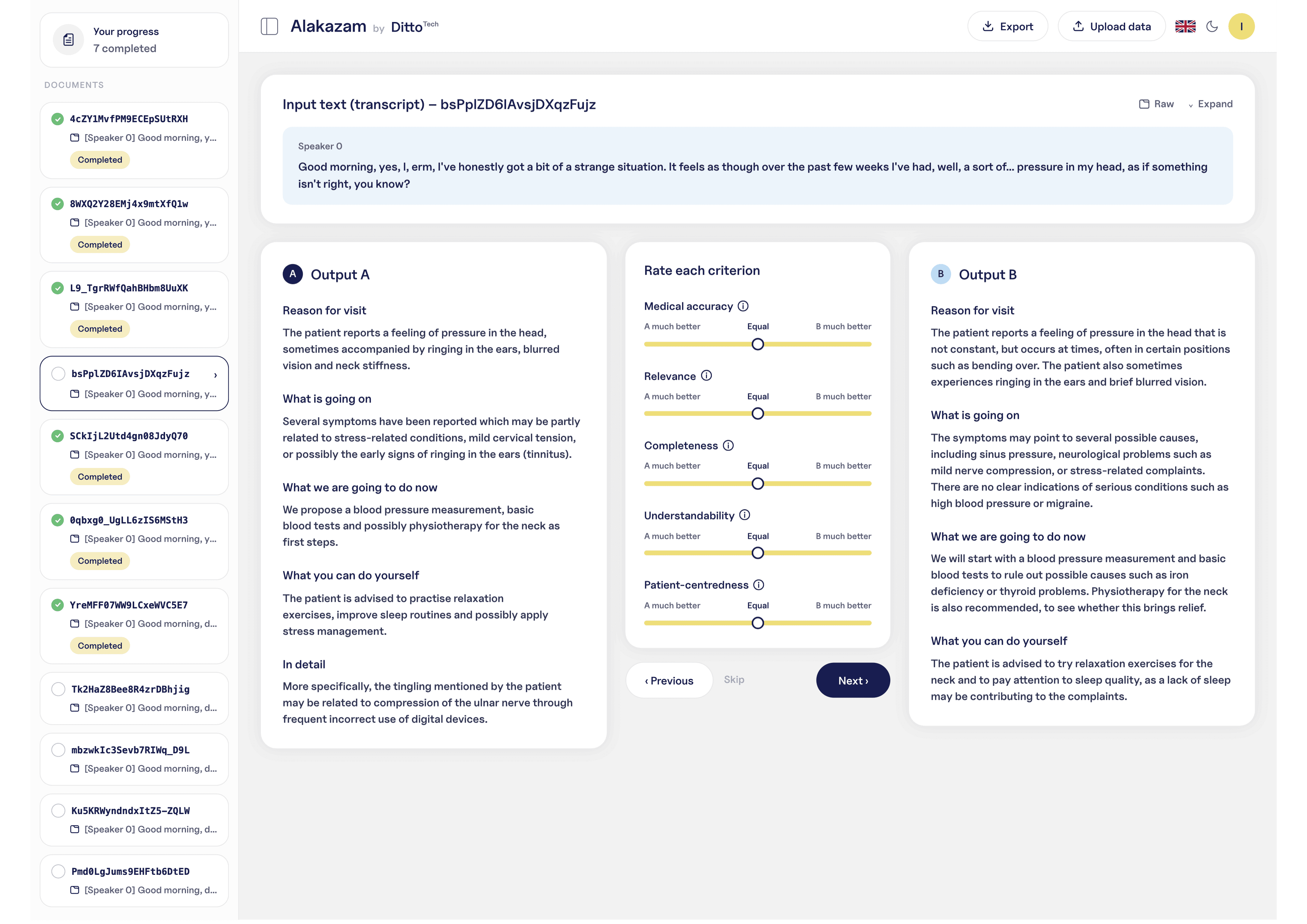
Reviewers were also free to annoter the summaries, which also let them explain their decisions and add context. We chose this set-up because people are far more reliable at judging "which of these two is better" than at scoring a single summary on its own. Put differently: you can only really judge how good a summary is once you have seen an alternative.
Now the technical part. We used the experts' judgements to rank all the systems using the Bradley-Terry method. Which system works best? The medical professionals ranked the Ditto engine best. The mole came last.
Every error is unwanted, but not every error is equally serious
Not all mistakes carry the same impact or consequences, so we classify the errors the AI engine makes. By low risk we mean errors you would rather not make, but that pose no danger to the patient (i.e a lack of nuance, or an over-simplification). Errors that are genuinely unsafe pose a direct threat to the patient and must always be avoided: an invented medicine, for instance, or an incorrect diagnosis. According to the reviewers, every error the Ditto engine made fell into the "low risk" category. There were three in total.
It helps to see what such an error actually looks like. In one conversation, a patient described heart palpitations and an irregular heartbeat. The doctor was still investigating those symptoms. Our summary said: "This is called a cardiac arrhythmia." The word "possibly" was missing. Two reviewers spotted this independently of one another. We used that finding to improve our system straight away, instructing the AI to keep words like "possibly" in place for as long as a diagnosis is unconfirmed.
What do we do with this research?
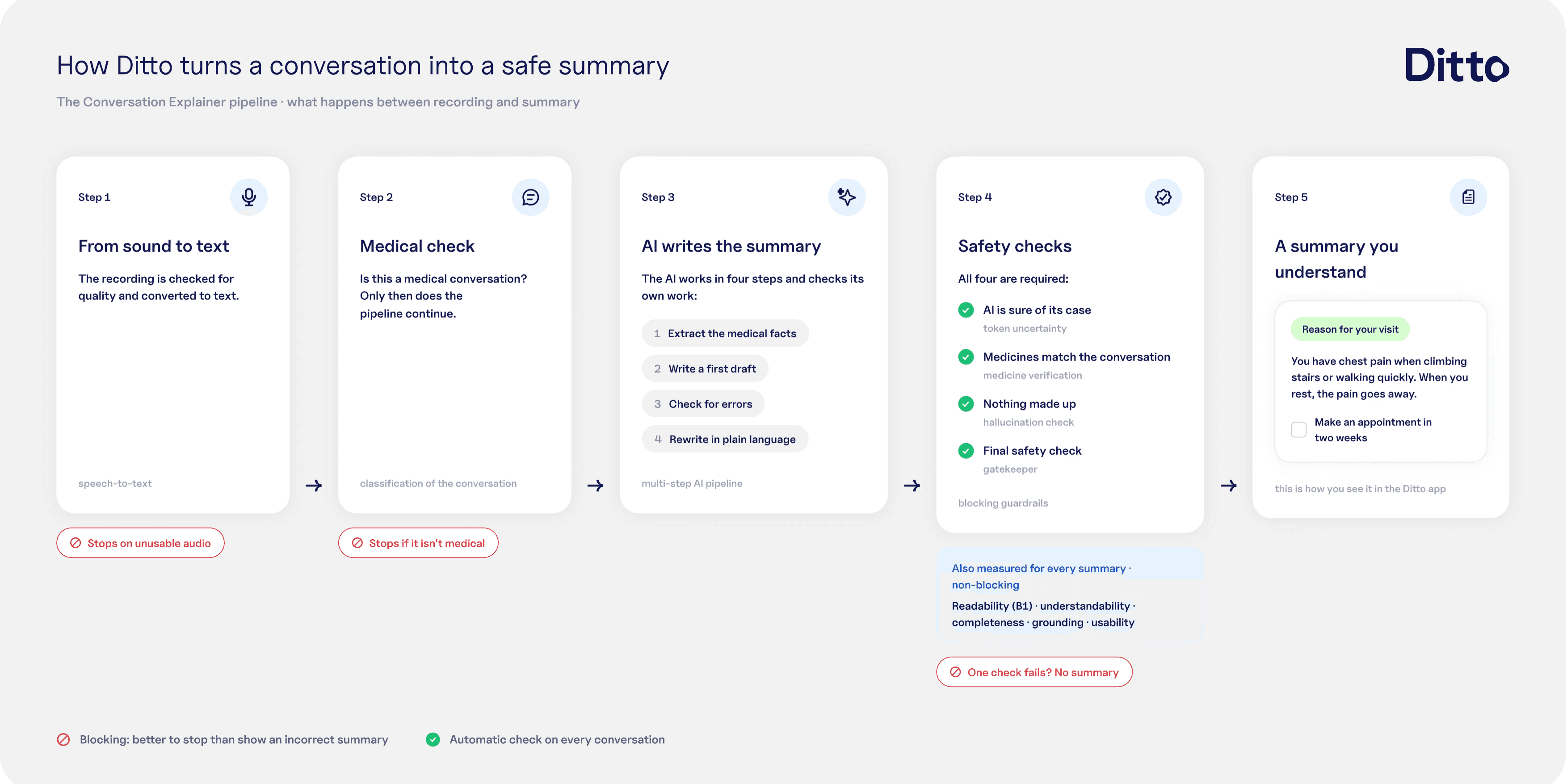
We use this study not only to understand the quality of our system, but to improve it. How does that work? At Ditto we run quality checks on every summary that is generated. We do this in two ways:
From a cockpit, we monitor how good our summaries are. That is difficult, because we cannot access the recordings or the summaries ourselves. Defining "good" is not simple either: we look at word count, complexity, word density and accuracy.
A number of these quality checks are designated as guardrails. These guardrails are crucial. If the check on one of them does not come back positive, we do not return the summary to the patient. The user can then ask for help from a doctor employed by Ditto, not for medical advice, but for a readable summary of their conversation.
What does a guardrail look like? Here are a few we currently use (we sharpen them constantly to make Ditto better):
Medication check: a system that uses a medicines database to assess whether any medicines have been invented or left out of the summary.
Hallucination detector: a check for anything mentioned in the summary that was never mentioned in the conversation.
Important to know: no human is looking over your shoulder. The checks are built into the system itself. Think of them as speedometers we calibrated in advance against a test set. In day-to-day use, we only see whether a gauge goes off. We do not see which car it is or where it is driving: the content of the conversation stays private.
Using AI in a medical setting is, of course, both exciting and nerve-racking. We are working at the edge of what new technology can do. For us, patients' understanding matters enormously. By giving people understandable information at vulnerable moments, Ditto meets both a real need and healthcare providers' obligation to communicate clearly. In the research described above, we offer a look under Ditto's bonnet.
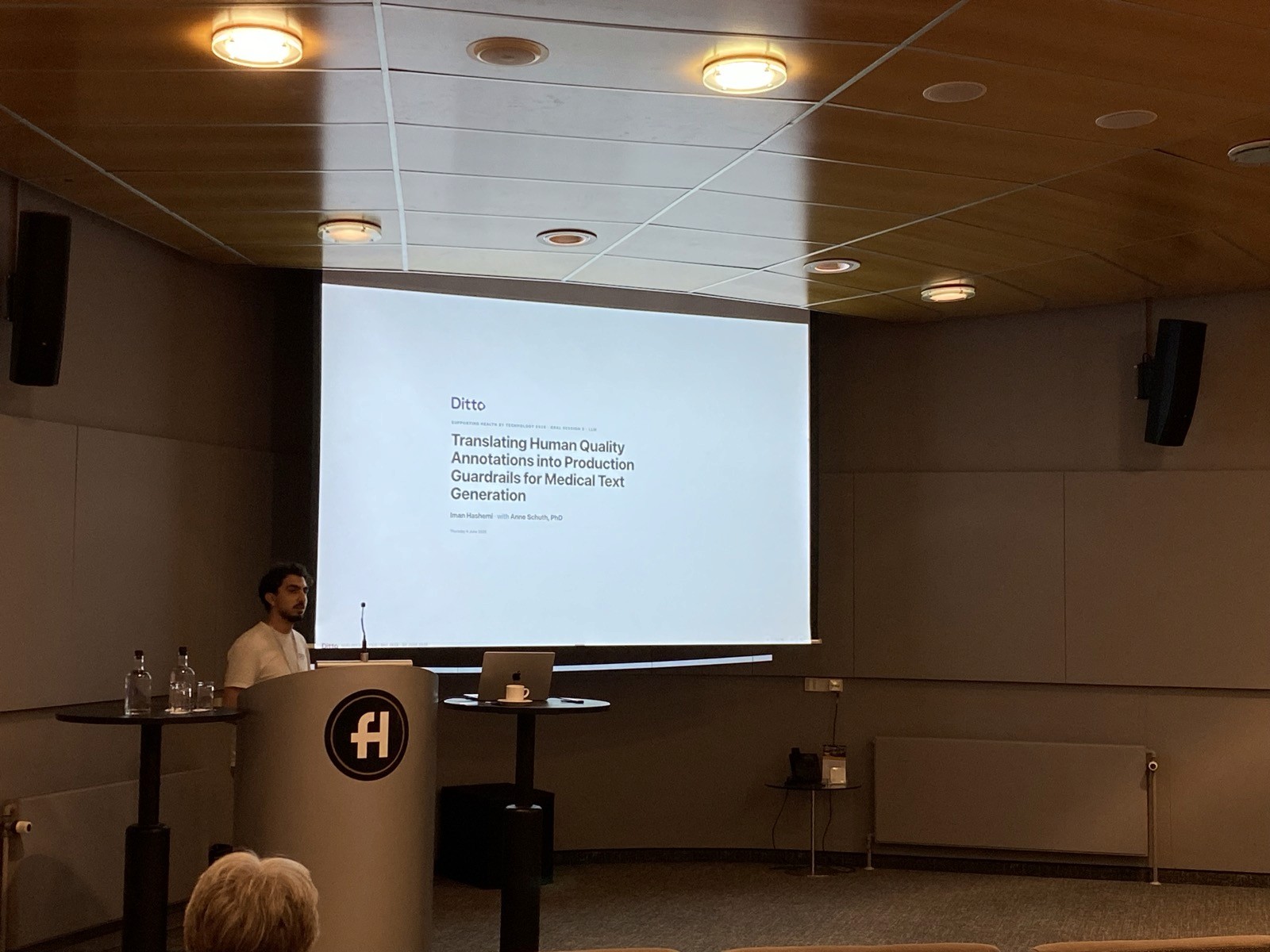
This work has not been left sitting on a pile. It has already led to several improvements in the logic and configuration of Ditto's AI, from the wording fix above to changes in how the system is set up and monitored. We presented the method and results at Supporting Health by Technology 2026 in Groningen, as joint work with Anne Schuth. A large part of the Ditto team consists of (former) scientists who completed doctorates on the use of AI technology.
Do you have more questions? Or are you a medical professional who would like to help assess and strengthen our validation? We would love to hear from you.
[1] Kessels, R. P. (2003). Patients’ memory for medical information. Journal of the Royal Society of Medicine, 96(5), 219-222. https://journals.sagepub.com/doi/pdf/10.1177/014107680309600504
[2] Jansen, J., et al., “Recall in Older Cancer Patients: Measuring Memory for Medical Information.“The Gerontologist; Volume 48:2, (2008):149–157, https://doi.org/10.1093/geront/48.2.149
[3] Hoek, Amber E et al. “Effective strategy for improving instructions for analgesic use in the emergency department.” European Journal of Emergency Medicine; Volume 48, (2013): 210-3. https://doi:10.1097/MEJ.0b013e328357a6dd
[4] Van Veen, D., Van Uden, C., Blankemeier, L., et al. (2024). "Adapted large language models can outperform medical experts in clinical text summarization." Nature Medicine, 30, 1134–1142.
[5] Asgari, E., Montaña-Brown, N., Dubois, M., Khalil, S., Balloch, J., Au Yeung, J., & Pimenta, D. (2025). "A framework to assess clinical safety and hallucination rates of LLMs for medical text summarisation." npj Digital Medicine, 8, 274.